

Mysticalligraphers
Future Calligraphers Scholarship Program
The mission of this scholarship program is to introduce young people to calligraphy. Students from a wide range of backgrounds have taken classes. Because of the online format, students can participate from all over. They have come from urban areas, communities of color, homeschool and more. Starting in the summer of 2025, we are very excited and grateful to now be under the organizational umbrella of Mysticalligraphers, Connecticut’s calligraphy guild. This scholarship program was started in 2020. Pictures are of student work.

How it works
100% of scholarship donations go towards supplies and shipping costs. The time, energy, outreach, fundraising, online costs and teaching for the scholarship students is donated. That is more than 100 hours of work annually to make this program possible. Debby Reelitz and Lavell Thompson donate the teaching, administrative work and technology. Scholarship students receive the same quality supplies that all of Debby Reelitz’s students use. Quality materials are a very important component of the classes. Too often students are given inferior equipment and then we wonder why people give up on art. Quality materials reduce frustration and improve results!
Picture above: after first ever class doing calligraphy–Elementary Student, Nigeria
Class: Calligraphy Camp, Day 1 project, add color to lower case blackletter
Classes taken by M: Calligraphy Camp Blackletter, Uncial 6-week, Illumination, Modern Calligraphy

How you can help
If you’d like to support this effort to foster diversity in the calligraphy community and introduce calligraphy to young people, there are three possible ways:
1) make a donation
2) help me connect with art teachers in middle and high schools in urban or rural communities
3) help me connect with students interested to trying calligraphy (recommended grades 5-college)
If you are an interested student or teacher, please call or email me. Phone: 860-550-3002 calligraphydebby@icloud.com
Picture: Mallarie and Johanna, Connecticut, middle school
Class: Calligraphy Camp Uncial
Ways to Contribute
- Check payable to Mysticalligraphers.
Mail to: Lavell Thompson, 4 High Street, Farmington CT 06032
(please note: Future Calligraphers Fund) - Venmo @Lavell-Thompson-1
please note: Future Calligraphers Fund - All donations are tax-deductible. Mysticalligraphers is a 501(c)3 organization.
Lavell Thompson, third generation calligrapher, member of Mysticalligraphers, former President of the HillStead Museum Board of Directors and financial executive, oversees the finances of the scholarship fund.


Art teachers are key
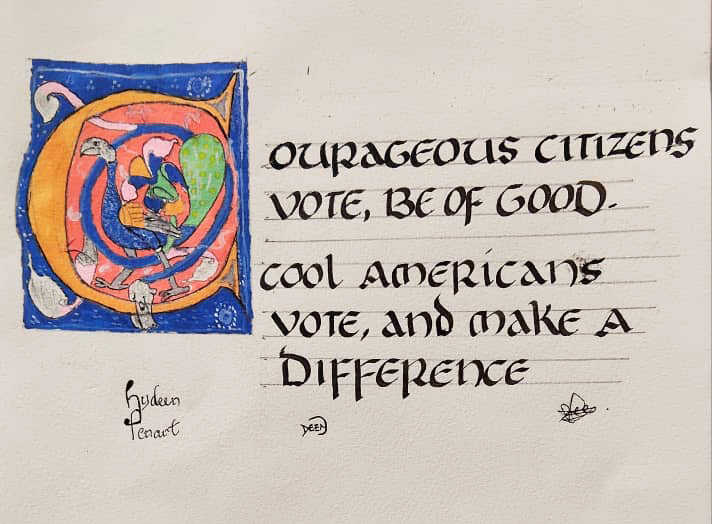
We have built (and continue to build) connections with high school and middle school art teachers in urban communities and communities of color. Art teachers are welcomed and encouraged to take calligraphy class(es) through the scholarship program. With teacher support and guidance, since 2020, we have had more than 40 students participate in almost 70 multi-week online classes. Those 40+ students have received collectively more than 650 hours of instruction.
Picture: Art Teacher Kelly, Hartford Public Schools. Calligraphy Camp grafitti project, in process
Can students continue?
We are thrilled that so many students have taken multiples classes and thanks to the generosity of this community, any student in the scholarship program is welcome to continue their study in additional programs at no cost.
While scholarship students can start in any of our introductory online programs, each summer we offer an online Calligraphy Camp as an entry into this special art form.
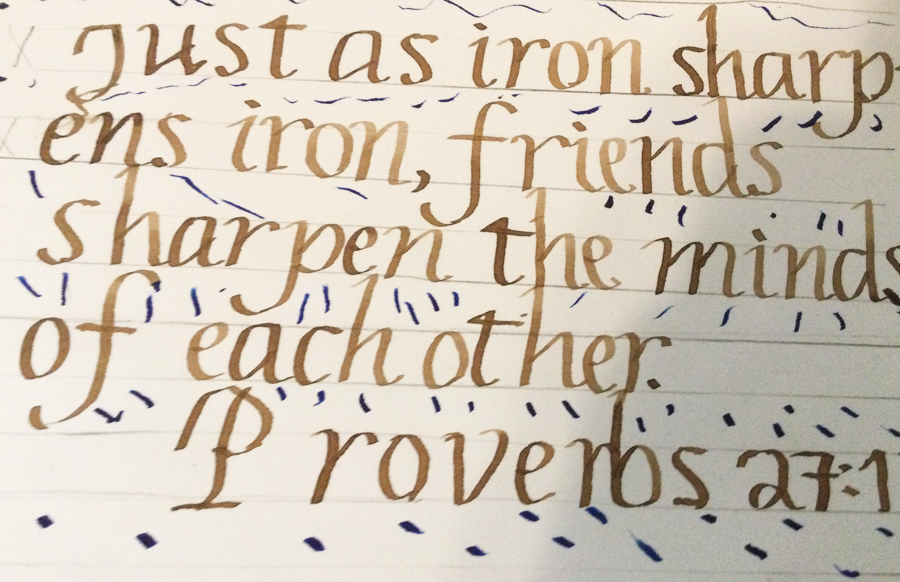
Picture: College student, Nigeria
Class: Illumination, historical decorated versal combined with uncial
Classes taken: Calligraphy Camp Blackletter, Uncial 6-week, Illumination 6-week, Modern Calligraphy
How the Scholarship started
The events of 2020 were overwhelming. For calligrapher Debby Reelitz, what emerged was a strong desire to not just continue teaching but to reach audiences that generally don’t get the opportunity to learn calligraphy. Sometimes the roadblock is financial, sometimes lack of opportunity. This scholarship program is designed to tackle one and/or both obstacles. The goal is to improve diversity within the lettering community across race, income and age.
Picture: left-handed middle school student, Connecticut
Class: Italic
Classes taken: Modern Calligraphy, Uncial, Illumination, Foundational, Layout & Design, and Italic.

Nigeria
In December of 2023 Dera Onuchukwu, a lettering artist from Nigeria, reached out to me asking about the scholarship program and expressing her desire to learn calligraphy. Through the scholarship program, she started with Foundational, then Italic. Friends and family asked her about the opportunity to learn calligraphy and by the summer Calligraphy Camp class, we had 4 more Nigerian students starting their calligraphy journey. A college student studying psychology; an upper elementary student; a high school student and an artist in his mid-20s. We continue to meet over WhatsApp to answer questions and keep up with the calligraphy. The high cost of shipping, limited access to calligraphy materials, papers, ability to print and inconsistent internet access adds to the challenge but we are persevering thanks to the financial support the scholarship program provides!
Picture: Dera, Nigeria/Canada, Italic class
Classes taken: Foundational, Italic, Calligraphy Camp Blackletter, Uncial, Illumination, Building Illumination Skills: African Inspirations, Blackletter, Circles Spirals and Curves, Modern Calligraphy, Copperplate.

Galleries of Student Work
Over 30% of scholarship students have taken a class and continued taking classes. Of the 42 students that have been a part of the Scholarship Program, 14 students have continued their calligraphy journey and taken more than one class. Those 14 students have taken more than 50 multi-lesson classes (more than 700 hours of instruction) since the Scholarship Program was started in 2020.
Does everyone catch the calligraphy spark? Of course not. There is even a very small number of students that have signed the scholarship form, received calligraphy supplies and never shown up to class. A handful of students have signed up and only come to a lesson or two. The vast majority of students complete their 5-day or six-week class.
Picture: high school student, Nigeria
Class: Illumination, Versal letters
Classes taken: Calligraphy Camp Blackletter, Uncial, Illumination
ASA
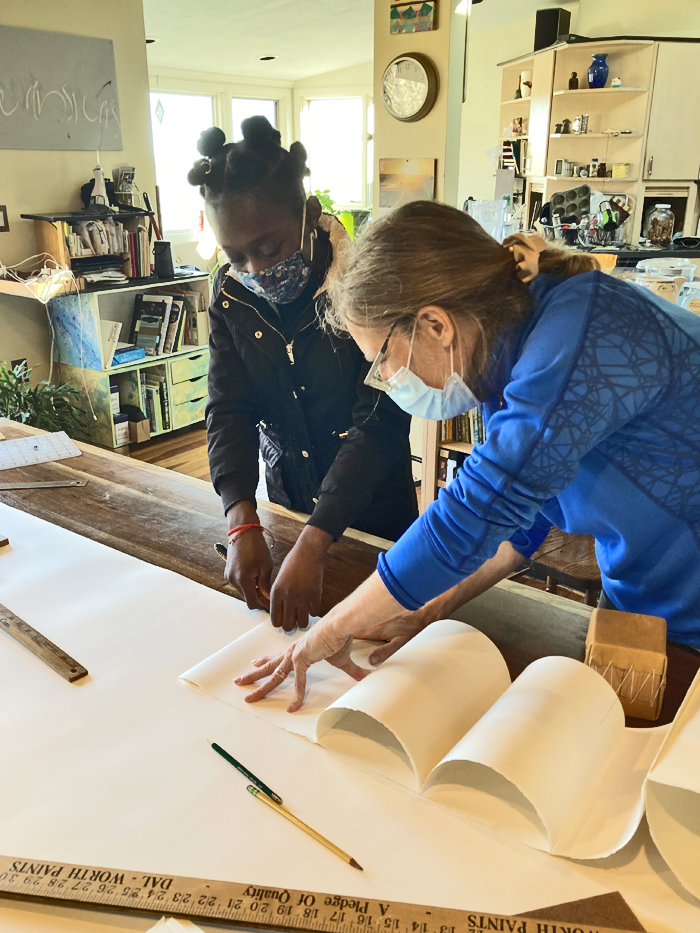
Asa’s book for SNEAP
Thanks to her middle school art teacher, Asa connected to the scholarship program soon after it was created. During that difficult pandemic school year, Asa took Intro to Foundational, Illumination and Modern Calligraphy. As a result of her interest and diligence, she was invited to participate in The Scriptorium, a 9-month journey to study manuscripts from around the world. Here she is building her book for her final project.
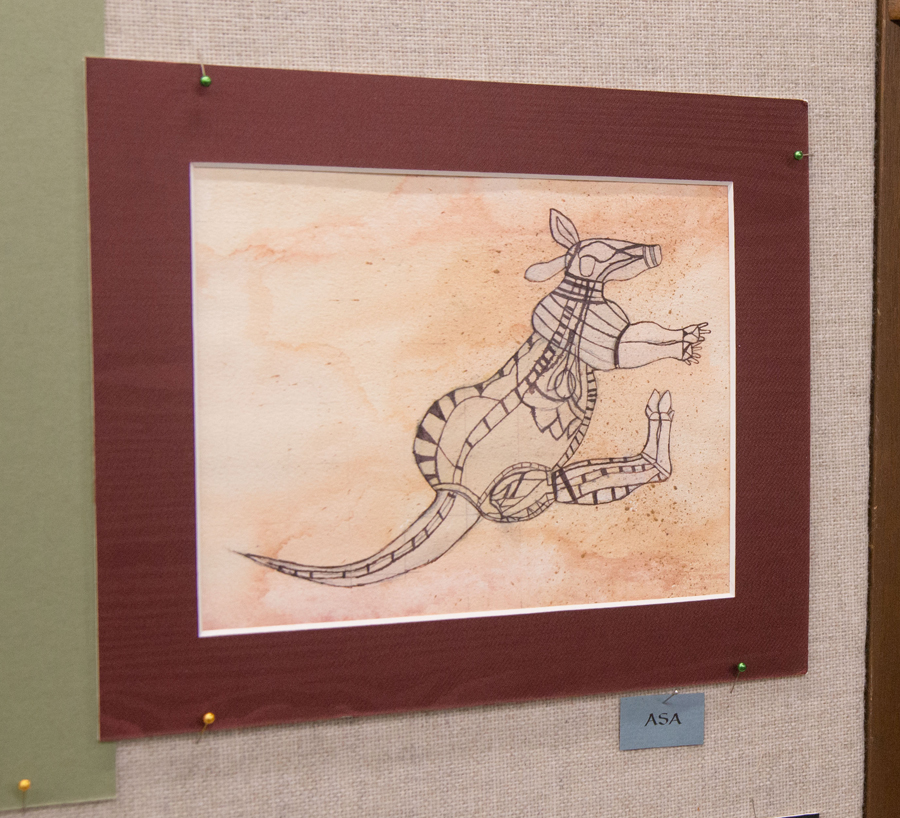
Asa’s Kangaroo
To develop our drawing and painting skills, we took inspiration from ancient cave art. Here Asa captured the intricate drawing of a kangaroo on the ceiling of the sacred Garbarnmung Cave in Australia.
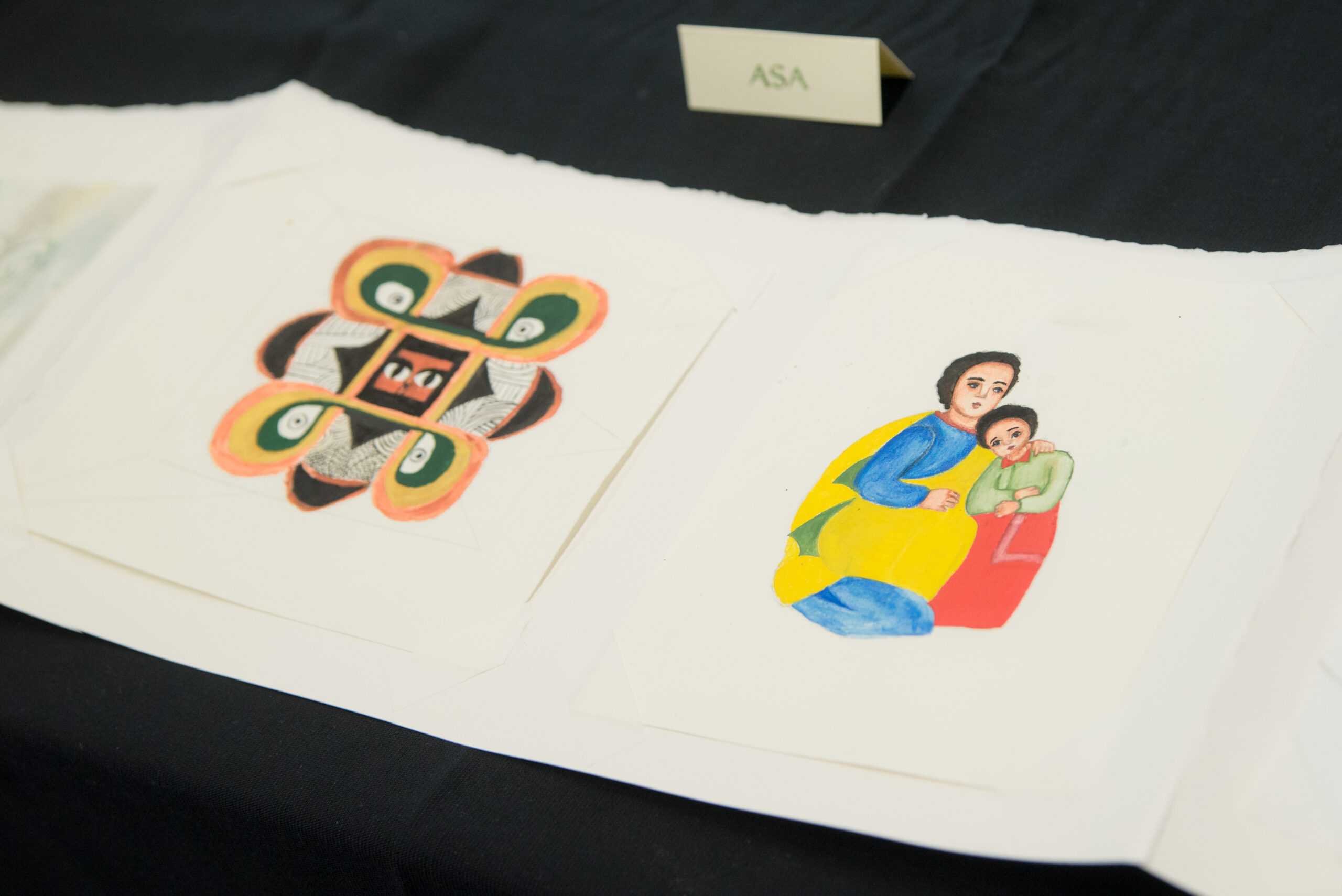
Asa’s Studies from Ethiopian Manuscripts
Asa had a particular interest in drawing faces. Here is her project from the Ethiopian healing scrolls (left image). These scrolls often include faces surrounded by pattern work. The mother and child image was inspired by the Ethiopian manuscript, St Michael the Archangel.
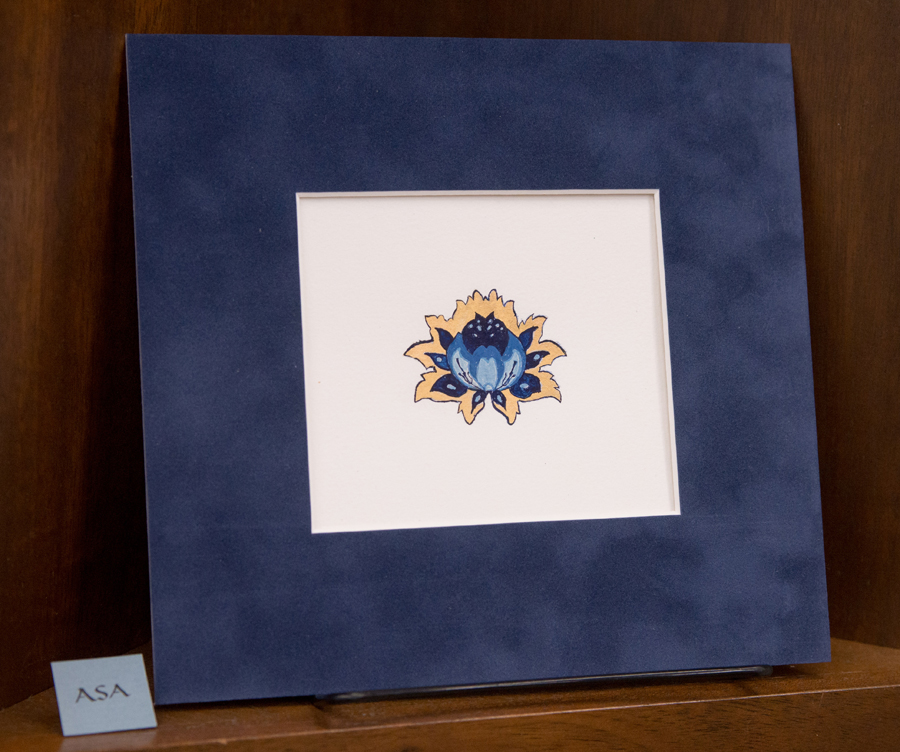
Asa’s Halkar
During the Scriptorium, we studied Islamic manuscripts. Here Asa created a halkar of only a couple of inches in width and yet with careful detail. A halkar is a stylized flower common to Islamic artwork.
STUDENT A
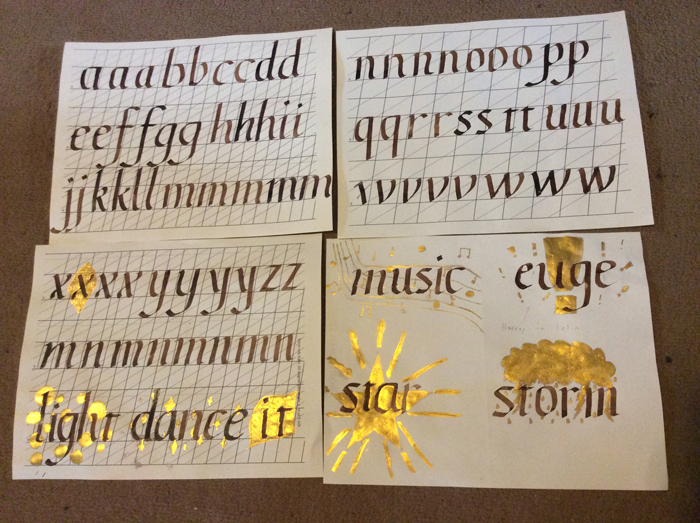
Student A
A started her calligraphy journey in 2022. As an upper elementary student, she began with the Uncial Calligraphy Camp. She has also taken the 6-week Uncial course, Modern Calligraphy, Italic, Blackletter Calligraphy Camp, and Illumination. She is also a talented Flamenco dancer.
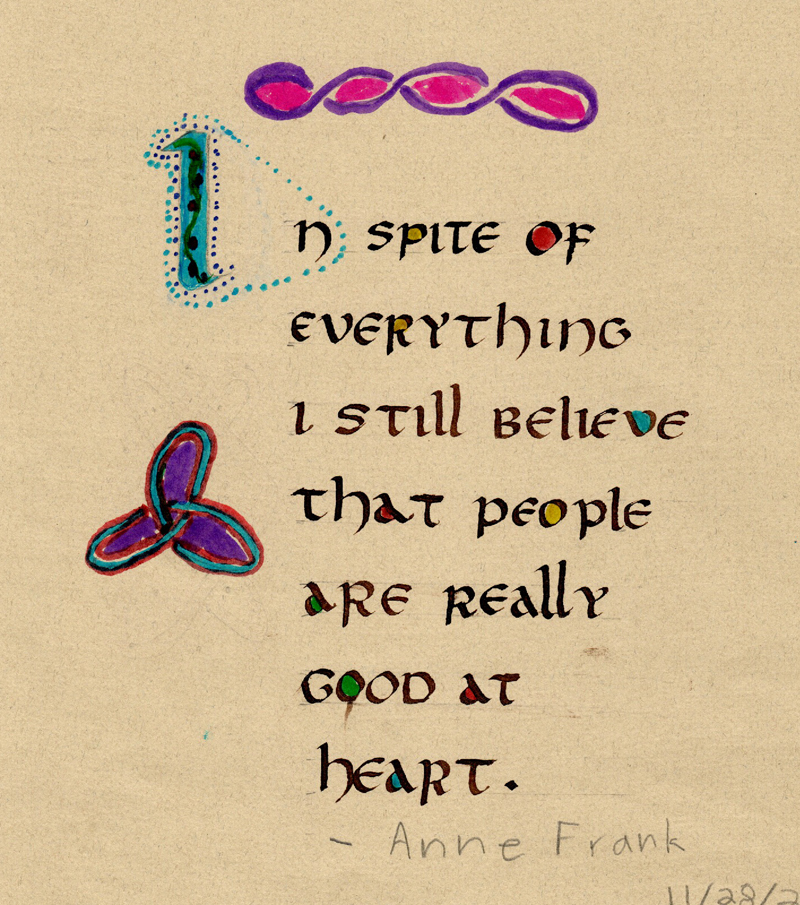
Learning calligraphy and layout
This project is from week 5 of the 6-week Introduction to Uncial Calligraphy. Student A used gouache, a Brause 2 mm nib and walnut ink. We used the Book of Kells for inspiration and added color to the counters of some of the letters.

Uncial Calligraphy Camp
Student A started with the Calligraphy Camp Uncial in 2022. Students worked with the 2mm Parallel Pen and used different interlinear spacing in their project.
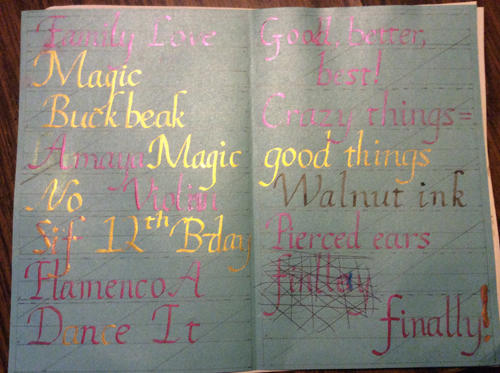
Students don’t start with italic
Students cannot take the Italic course before taking an Introductory course. Now a middle school student, A took the 6-week Italic course where students write with metallic gouache and write on a variety of papers to start learning the subtle differences between papers and writing mediums.
STUDENT D

D’s decorated versal letters
As an elementary school student, D came to a couple of library calligraphy programs I taught. I invited him to participate in the scholarship program. Starting in middle school, since 2022 D has taken: Calligraphy Camp Uncial, Modern Calligraphy, 6-week Uncial, Italic, Calligraphy Camp Blackletter, Illumination, Building on Illumination Skills: African Inspirations, 6-week Blackletter.
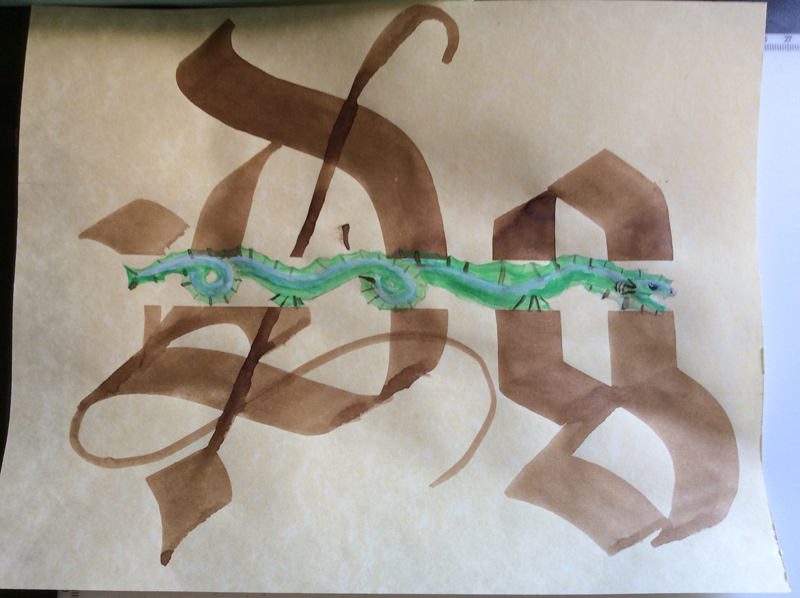
D’s Blackletter with the one inch pen
In the 6-week Blackletter class we start with a one inch pen. Writing very large builds a clearer understanding of the 30 degree pen angle. For the second class we progress to the 5 mm Brause nib. The fourth class we move to the 2mm nib.

D’s Blackletter homework project
Here is an example of Week 5 in the Blackletter class. D is writing the body of text with a 2 mm Brause nib and gouache. The large versal letter is created with a double pencil tool. Learning to write with gouache is an essential skill and why I teach with dip nibs primarily instead of cartridge pens which are more limited.
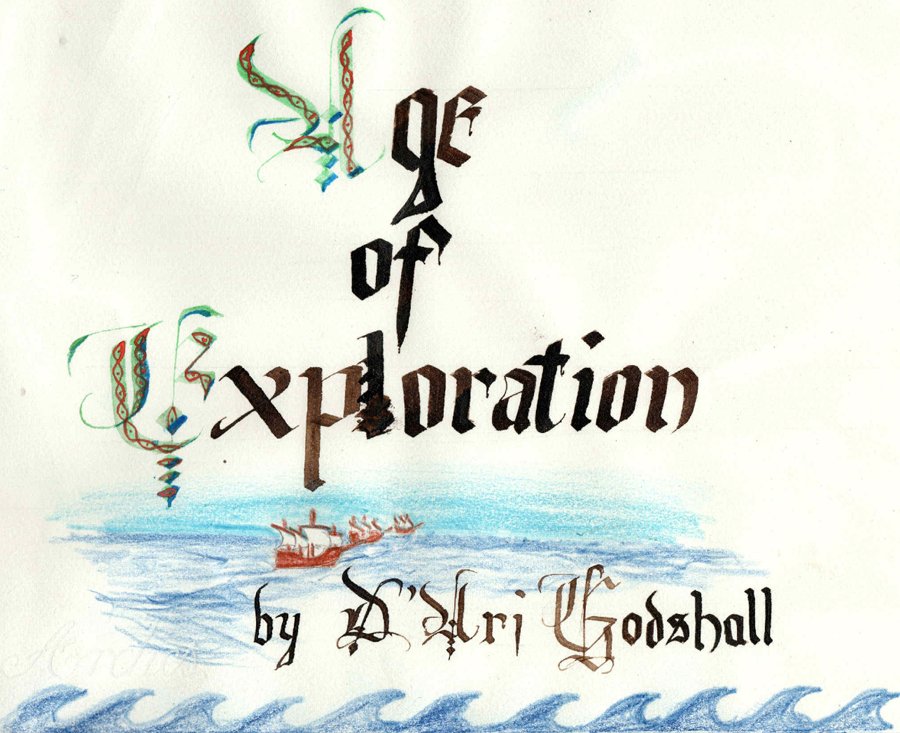
D’s school report cover
A huge fan of Blackletter caps, D uses his Blackletter skills for a school project report cover.

D is drawing with a grid
In the Building Illumination Skills class, we practice ‘seeing’ with a grid to improve our drawing skills.

D’s dragon with details
Developing the dragon, gave D a great chance to practice his painting and blending skills as well as fine delicate line work.

Developing Brush Control
In the Modern Calligraphy class, we mix up the practice. Rather than only practice letterforms, we build our brush skills with a variety of activities, including a zebra, learning to add pressure and create tapers. D captures the thick and thin of the zebra stripes with single strokes.

Designing and completing a layout
Uncial 6-week class. Week 5 project adding knot borders to lettering. 2mm Brause nib.
DERA ONUCHUKWU
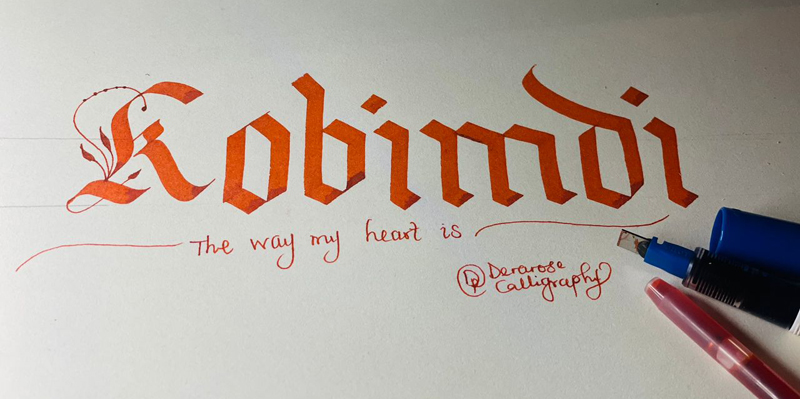
Dera’s persistence
Dera has done so much on her own to learn calligraphy. She has been creating elaborate cards and gifts with her lettering well before meeting me. What she needed access to was traditional calligraphy tools and instruction. Donations to the scholarship fund make these resources possible for Dera and the other Nigerian students. I am very grateful for Dera’s work as a liason, connecting us all together.

Dera learning uncial and knots
Dera’s fourth class was the 6-week Uncial course. For our fifth class, we create a broadside incorporating a versal letter, calligraphy and a decorative border using the Book of Kells as our inspiration.

Dera’s bookmark assignment
Also created in the Uncial course, this bookmark project highlights the work we do with gouache. Learning to letter with gouache allows calligraphers to work with a medium that is pigment intense and long lasting. Gouache also results in better lines, less bleeding and has infinite color possibilities.

Putting the illumination skills to work
An independent project Dera created after her participation in the Illumination course. We explore the decorative possibilities of Lombardic versals. It takes serious practice to get fine white decorative lines.

Dera’s knot practice
This pencil works shows the kind of persistence it takes to understand how to create knotted designs. Knotted borders show up in manuscripts from all around the world and are a joy to create once we get a solid understanding. In the Building Illumination Skills: African Inspirations class, we studied knots from several historical Ethiopian manuscripts.

Where Dera started
I knew Dera was serious about learning calligraphy when she reached out to me. Her Instagram page was full of lettering projects and elaborate cards she had created with the tools she had available to her, markers and pens. The calligraphy supplies and online instruction have allowed her to expand her skills significantly .

Building design skills
Learning calligraphy and learning layout and design skills are not two distinct goals. Applying one’s calligraphy to a project means that layout and design knowledge is developing right alongside the lettering skills. Here Dera uses her italic in the Circles Spirals and Curves class.
MOMOH

MomohProject
When we met in the summer of 2024, Momoh was in his senior year of college studying psychology in Nigeria. Starting in the summer of 2024, he has taken: Calligraphy Camp Blackletter, 6-week Uncial, Illumination and Modern Calligraphy Above is an independent project using his blackletter skills.

Momoh’s first day
Calligraphy Camp was Momoh’s first class with me in the summer of 2024.
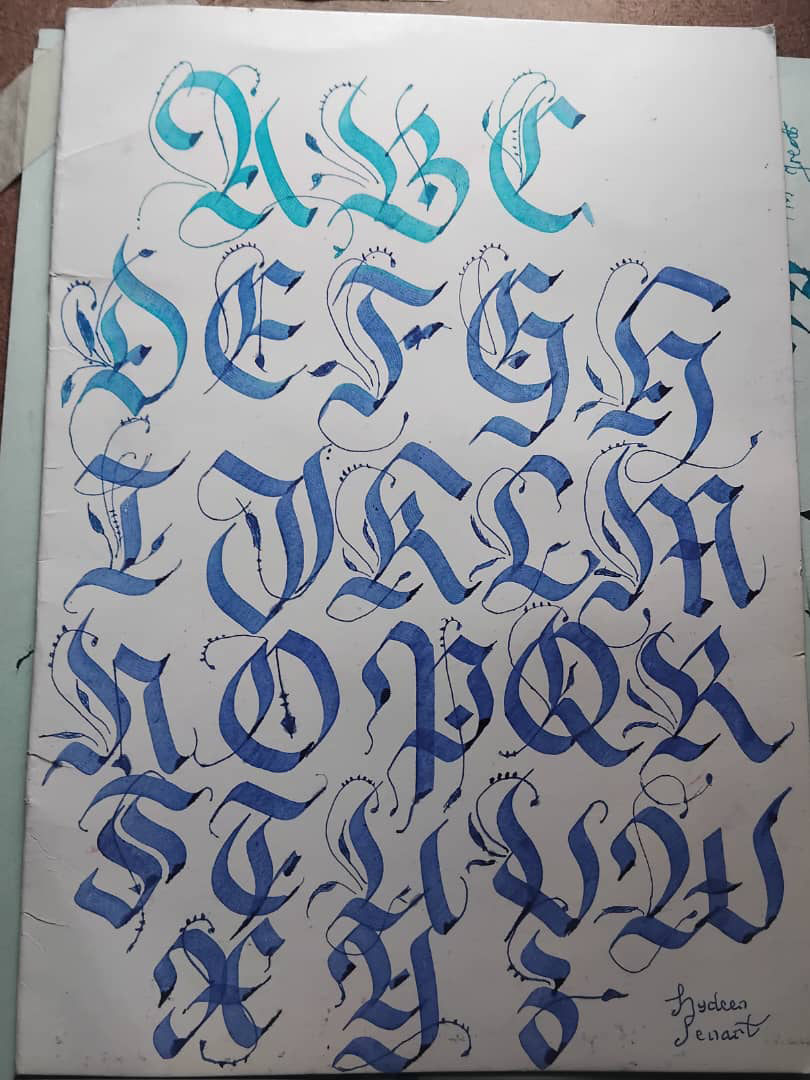
Momoh’s blackletter caps
I love the way students inspire each other. Both D and Momoh were in the Blackletter Calligraphy Camp and D’s elaborate capitals (since he had at least a couple of years of experience already) were way more exciting than the basic forms I was offering my students! LOL Seeing D’s capital forms inspired a lot of practice by all the students. The Calligraphy Camps are the only classes where I teach with the Parallel cartridge pen.
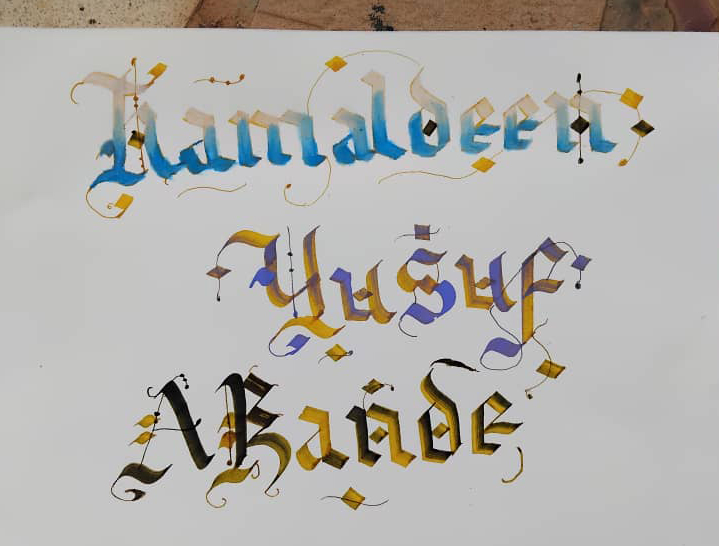
Learning strategies to decorate letters
In the Calligraphy Camp, we also work on color techniques, not just the letterforms. Being able to create projects with letters is just as important as the letters themselves.
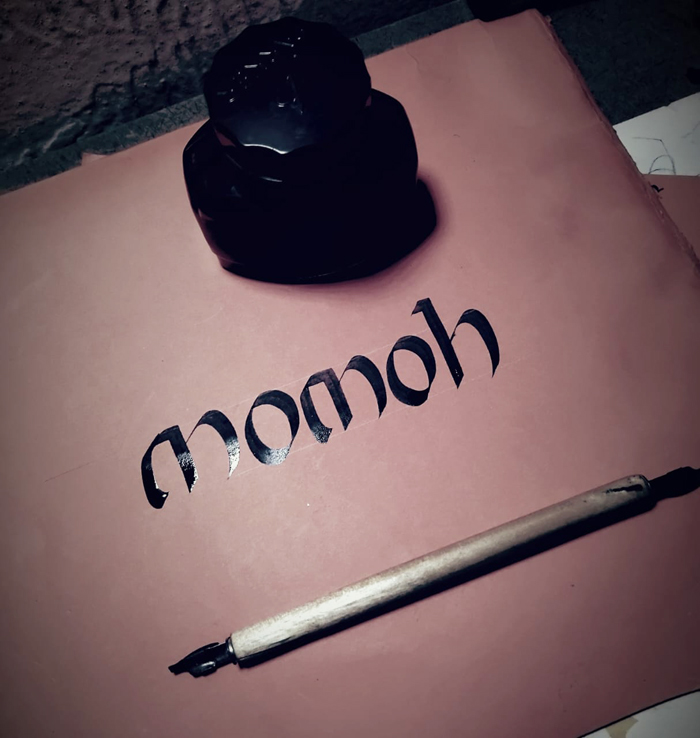
Momoh’s uncial
The second class Momoh took was a 6-week class on Uncial. There he moved from the Parallel cartridge pen to a Brause dip nib and ink. Using a dip nib allows a wide range of lettering techniques that are not possible with a cartridge pen.
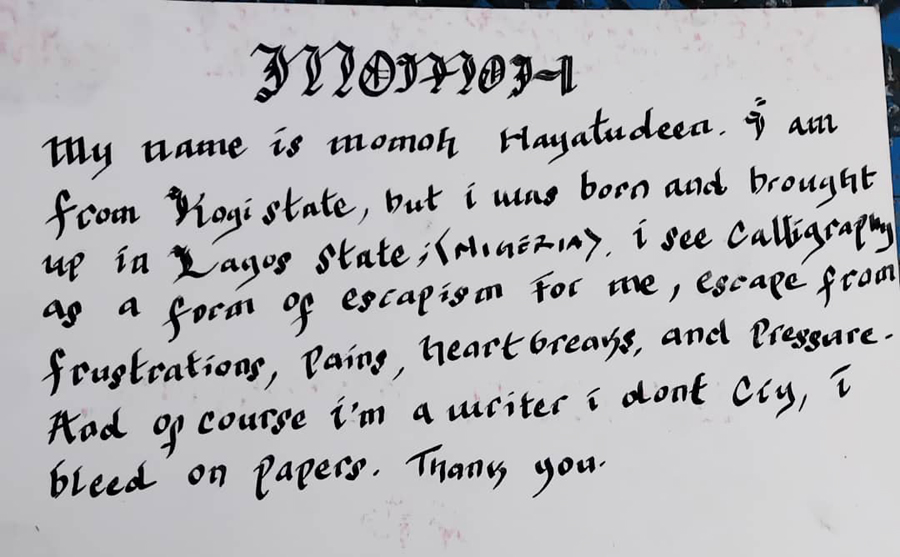
Momoh’s love of calligrpahy
Momoh shared with me this special piece of calligraphy he created prior to us meeting. I encourage all my students to keep samples of their early work so they can see how far they’ve come. He has allowed me to share this special early piece with you.
VICTORIA
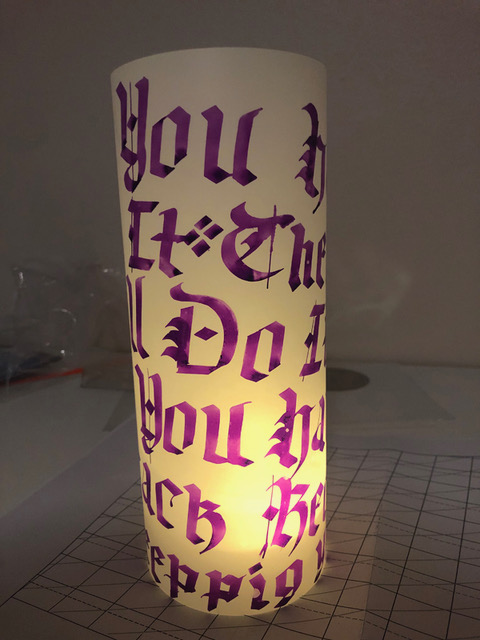
Victoria’s Blackletter Lamp
Victoria, had just graduated from high school in Dallas, Texas. She found out about the scholarship program through a dear friend of mine from college. She took the Calligraphy Camp Blackletter in 2021 and continued on with Illumination and Modern Calligraphy.

Victoria’s Modern Calligraphy
I so love hearing from students after they have taken classes. Sometimes it is a few months later, sometimes it is years. Here Victoria used her Modern Calligraphy skills while she was at college for an organization she volunteered with.

Victoria’s Poster for College events
Victoria’s skills being put to good use–working on a curve, adding a shadow highlight, creating an interesting yet readable design.